Thursday, March 31, 2016

Why Having An Idea Is Good Enough

When the recession hit in 2008 people lost jobs left and right. Employers had to fire lifelong employees. All of this created the perfect conditions for the millennial entrepreneur to flourish. Because the traditional career was no longer a guarantee, millennials were willing to accept the risks that come with being self-employed.

Instead of working the typical nine-to-five job, many among gen-y started their own business ventures. Now some of the most successful businesses are run by those millennials whose thinking was shaped by the uncertainty of the recession.

However, despite these examples of millennials many among my generation still miss opportunities hidden in plain sight because they seem unreachable. Mobile app development is a great example of how an idea can be good enough.

First off, apps are an interesting business because there’s a perception that one needs to know how to build their own apps from the ground up. Coding experience helps, but that’s a bit like claiming that the CEO of a car manufacturing company should be able to build a car from scratch.
As CEO, she has a role, which is that she must manage and be familiar with every other role. Most of all, the CEO is a manager of ideas and a strategist.

You don’t have to do everything – you must be willing to, but figure out what you can do and start there. The Yik Yak you know began on a napkin – it was just an idea. Venture capitalists will fund ideas nowadays if you can present with proof of concept. Startups look for seed funding, but in the early two-thousand-teens pre-seed investing started, where investors will literally fund a concept.

My point isn’t that you should just wait around with your brilliant idea, but rather, that if you’ve exhausted all your options in getting it past the idea stage, you just need to keep pushing. If you know what you’ve got is gold, then look for the reasons why it should happen, and why it can. Remove can’t from your vocabulary. If you have a great idea you can will it into existence.
Saturday, March 26, 2016

Letter From A Millennial Technophobe


            A digital native is an individual who was born after the widespread adoption of digital technology. The term was popularized by education consultant Prensky in his his 2001 article titled “Digital Natives, Digital Immigrants,” and is often used in relation to millennials.
            However, not all millennials are digital natives in actuality. Despite growing up in the middle of this era when technology has become prevalent in nearly every aspect of our day-to-day lives, I spent my free time outdoors.
            I didn’t even have Facebook or any other social media until about six months ago. When it comes to technology I relate more to the older generations than my own. I considered social media to be a waste of time and an exercise in vanity. Ironically, I’m writing under the assumption that this will interest someone, which is a bit vain as it is, but I’ve learned quickly that in today’s marketplace – whether, it’s jobs, dating, or just staying current, online presence is a must.
            I was taken aback when I graduated and began applying for jobs in my desired career path how many asked for your social media links and your blog. I was unprepared. This rude awakening caused me to get into social media, which warmed me up to other apps designed for making life easier. Facebook, Instagram, and Twitter make socializing an activity without borders, much in the same way there are apps designed for transferring money, and almost any other task you can think of.
            As someone who’s been technology illiterate I can empathetic, but it’s worth embracing this change. Here’s a list of 10 useful apps to get you started…

1)   AroundMe
2)   Venmo
3)   Waze
4)   Uber

5)   Swoopzoom

The Tolerant Generation*

I had a conversation with a family member a few years back that’s stuck with me since. I was telling him how proud I am of my generation for being so accepting of people regardless of their race, sexual orientation, or socioeconomic class. His response: It’s easy to be accepting when you have no room to judge. Translation: Millennials are losers so if your generation condemns others then you are essentially condemning yourself.

As much as we highlight the negatives, in my lifetime I’ve seen tremendous progress. I believe my generation has been critical in the push for gay marriage and opening up dialogue about other kinds of inequality.  If being “losers” is the reason we are accepting of others, if that’s the characteristic that’s enabled Gen Y to continue to fight for equality for all then call me a loser.

Baby boomers paved the way for us to even be in the position we’re in. They lived through the civil rights era. But millennials are tolerant because we’ve learned from the baby boomers, the very same people who think we are losers, that social change requires dissatisfaction.

Our dissatisfaction keeps us from being complacent with the progress we’ve made. My generation is accepting because we won’t settle for “kind of equal” (there’s no such thing). We’ve been nicknamed the Me Generation because of how we are perceived to value ourselves highly, but we place the same value on others, which is why we are sympathetic to their needs. Gen Y’s tolerance for others is not for any deficiency, nor is it a claim to superiority over past generations. We have benefitted from history and have had the opportunity to build on the strides towards equality made by past generations.

The accepting attitude of my generation stems from our strong sense of individualism – we like our wants and needs as individuals to be recognized. As a social strategy, whether done knowingly or not, we have to consider where others are coming from in order for the same courtesy to be extended to us.

I’m not at all claiming that my generation is noble or better than any other, but I stand by what I told my family member years ago: I’m proud to be a millennial because we are progressive and accepting of people from all backgrounds.

Tuesday, March 15, 2016

Why Gen-Y Describes Itself As Spiritual and Not Religious


1) We aren’t against religion – we’re against division 


Millennials are digital natives in our youth the advent of social media has played an enormous role in making us think globally. We’ve had a better opportunity to get real time global perspectives than past generations instead of information being filtered and twisted by traditional media into propaganda we have a multitude of ways through social media to get closer to the source. Millennials have to choose to be ignorant in this day in age with how much information we have available and the variety of ways we can receive it. In this regard, Millennials have to willfully choose to act without compassion. 

How does this relate to religion? Religion itself is not the issue, but religion being used to justify homophobia and moral superiority is what turns millennials off. 


2) We look at religion pragmatically 


Call us naïve if you will, but we actually believe we can make this world a better place. If religion is used more often than not to promote hatred and ignorance we are okay with declining to participate in traditional religious institutions. If we sense it is being used as a weapon of division then my generation would rather be labeled insincere for calling ourselves spiritual rather than to promote anything other than unity. Yes, we do feel special – call us entitled. Millennials believe we can be the generation to utilize love and reverse the damages done to the world in the time before our own. 


3) We are afraid to commit – and that’s okay 


We’ve witnessed bad presidents, bad marriages, parents that are committed to companies that aren’t committed to them. We understand the pleasures that come with commitment; the strength and determination any human admires in another, but we’ve also seen the dark side of commitment; the brokenness it results in when one is devoted to the wrong person, the wrong ideology, the wrong cause, or the wrong war. If we seem “afraid to commit” it’s because we don’t believe the current model is sustainable. Theoretically, religion is one of the most serious commitments of all, but faith requires belief, so when millennials call ourselves spiritual it’s because we believe we owe it to ourselves to love others and live our lives with respect to traditions, but unhindered by those same traditions that have a history of being used to justify violence. We are skeptical of anyone or anything that advocates itself as the “right way” because we have had the privilege through the digital age to become global citizens.

The Greatest Renewable Resource: The Value of a Brand New Day

When I was in kindergarten I distinctly remember feeling anxious and energetic at once – a distraction to the other students. I felt ashamed and as a five year old I believed I was the absolute worst. 

One day my teacher, Mrs. Brooks came to our house to talk with me. She’d been teaching for twenty-five years and cared deeply about every single student. She could tell I was beating myself up about my inability to sit still and that my disappointment in my behavior was building. 

She told me, “Every day is a new day with a clean slate.” As absurd as it is to picture a five year old wracking himself with guilt this actually happened, but her words helped me out. My behavior improved as I thought of them, and the lesson she taught me has stuck with me ever since. 

The value of a brand new day is that you can use it however you choose to. The trick is making the most of the opportunity that comes from another sunrise often means balancing between being harsh with yourself or being too relaxed about your own standards. 

The perfect balance between the two is to do your best – your best is inherently imperfect, so it forces you to realize mistakes are unavoidable. However, doing your best also teaches you through the process that you can minimize your mistakes and optimize your happiness. 

In the same way that we search for truth through hyperbole as children, the fastest route to personal truth is pushing your own boundaries – the value of a new day is having the chance to know you left nothing on the table.

Networking The Right Way

Living in Los Angeles I can tell you firsthand a few of stereotypes about the people here are true. In this city everyone is trying to get something. People relocate to LA from all over the world, same as I did, to chase their dreams. It’s a different kind of hustle from New York City, but everyone is looking to climb. 

Being new to LA from Atlanta, to a certain extent I have to think about networking in almost every interaction. Back in Atlanta I was never like that, but my mentality shifted when I unpacked and made this my home. Now I consider whether acquaintances and people I meet will be beneficial to me more carefully than before. Here’s the caveat: 


1) Make sure you have something to offer in return

Consider every social favor you receive to be a loan. You need to have a way to return the favor – that’s the first step to networking with a conscience. 


2) Be direct

People can sense when you’re angling for something. If they want to help they’ll tell you, if not then hopefully they’ll be just as clear about that, it’s good to be a dreamer, but no one likes a schemer. 


3) Be genuine

When you’re networking it’s exciting to make connections that can be beneficial to your career, but don’t forget that you’re dealing with people who have their own needs and feelings. It’s a rule of proportions: you should never know more about the connections a person you’re talking to has than you know about them as an individual.

Wednesday, March 2, 2016

Planning for Growth vs. Planning for Success

The term “adulting” gets tossed around on social media frequently, and often in the context of millennials or recent college graduates confessing they have no idea what they’re doing. 

One of the most difficult parts of adulting is deciding what you want to do or making up your mind about what you want to be known for. Part of the reason this decision is so tough is that we’re overly concerned with the end result, which often leads to us shortchanging ourselves on the great advantage of being young. 

Youth is designed for learning. We can capitalize on this advantage if instead of thinking about the end goal we focus on what would challenge us enough to make sure we gain the skills needed to get to the final destination. That’s the difference between planning for growth versus success. 

But what does this look like in practice? 

Let’s consider two scenarios: 

In the first scenario you have the opportunity to make more money than scenario two, which is excellent in the short term – we can measure this as a kind of success – but you aren’t in your preferred career path. 

In the second scenario you’re making less money, but you’re in the career path you’ve dreamt of, thus giving you the chance to connect with mentors and invaluable learning opportunities. 

The long-term value of the second scenario outweighs the first; however, the short-term value of Option A is more obvious, and arguably more valued by society. The short-term option provides immediate stability, whereas planning for growth isn’t guaranteeing anything immediate, and that lack of certainty is a scarier feeling, but you’ll gain something you can’t really quantify – challenges and stimulus for growth. 

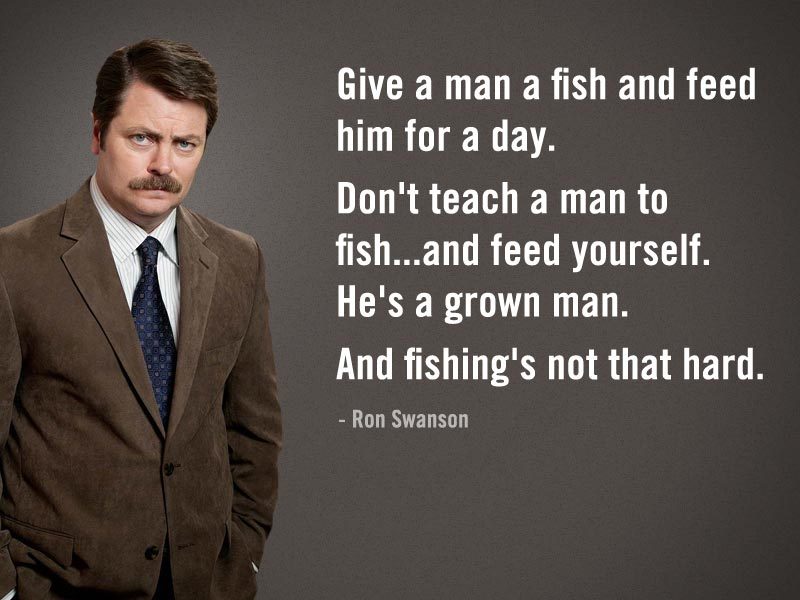
If you don’t know what the hell you’re doing or how to go about adulting, that’s okay, but just consider the proverb: Give a man a fish and he’ll eat for a day. Teach him how to fish and he’ll eat forever. 


YOU are the asset. YOU are the value. The short-term rewards will dwindle, but you increase your own value by focusing on your growth. Your experience is perpetually rewarding.

Telling Apart the Haters and the Concerned

Haters (as defined by Urban Dictionary) – A person that simply cannot be happy for another person’s success. So rather than be happy they make a point of exposing a flaw in that person.

When you’re young it’s critical to be surrounded by the right kinds of people. If you fill your life with Yes-Men then you stifle your self-awareness because no one challenges you to reflect on your actions.
On the other hand and perhaps more importantly, if you surround yourself with people who don’t believe in you or what you’re trying to accomplish then they can become deadweight as you try to move forward. 

Where it gets tricky is that the ones who are most concerned for us are often our biggest allies, but the concerned; the positive form of the haters, so often these two separate things sound eerily similar. However, it’s unwise to push those who care about you away, so become skilled at recognizing which is which instead. 


1) Look at their intentions 


If you can tell it’s coming out of a place of love that’s one immediate telltale sign. The concerned are afraid for you – just be grateful they care. The haters are afraid of you – the world is a small place to them because they lack self-belief – you are the competition that makes it even smaller to them, taking the opportunities they feel entitled to. 


2) Check for truth 


Haters feed off of fear, so use them, lose them, and don’t feel bad about it. Every now and then even a hater can help us improve. Use good judgment to decipher the truth in what they say if it can be beneficial. Take the input from them, but let them keep the fear. Once you’ve extracted what’s real from what’s not, treat these people like the plague. 


3) The concerned offer solutions 


The concerned offer solutions and try to help problem solve. Haters only present problems and don’t offer ways around them – unless it benefits them personally. Haters are driven by ego. If they could not succeed, they do not want to see you succeed where they failed. They will dismiss your progress, while the concerned will celebrate the smallest victories with you. 


About Us